Word Portraits from the Earth

Word Portraits from the Earth is a series of 27 stitched interpretations inspired by Living-language-land, a collection of specially chosen words from endangered and minority languages from all over the world. The words were researched and assembled by Philippa Bailey and Neville Gabie of the UK, in honour the UN Climate Change Conference COP26 in 2021.
My part in this collaborative project was to create 'word portraits' that would engage emotions and light up curiosity about these beautiful, poetic words, many of which have no direct translation to English. They bring together themes I'm passionate about: our relationship with nature, love of words and language, and earth-based spirituality.
Click on individual images to read their stories.
All contributions were created by the communities themselves, and all contributors received compensation to support their wider work. All contributions are shared under a Creative Commons Attribution-NonCommercial-ShareAlike 4.0 International License, unless otherwise noted. Attribution to the authors is essential. All supporting information can be found here: https://living-language-land.org.
Listen to my interview with organizers Philippa Bailey and Neville Gabie
I am open to doing presentations, by Zoom or in person, for educational purposes. Contact me for details
All the works except for the two round wall hangings are framed in black with non reflective art glass.The collection is now open for purchasing.
13X13" shadow box
SOLD
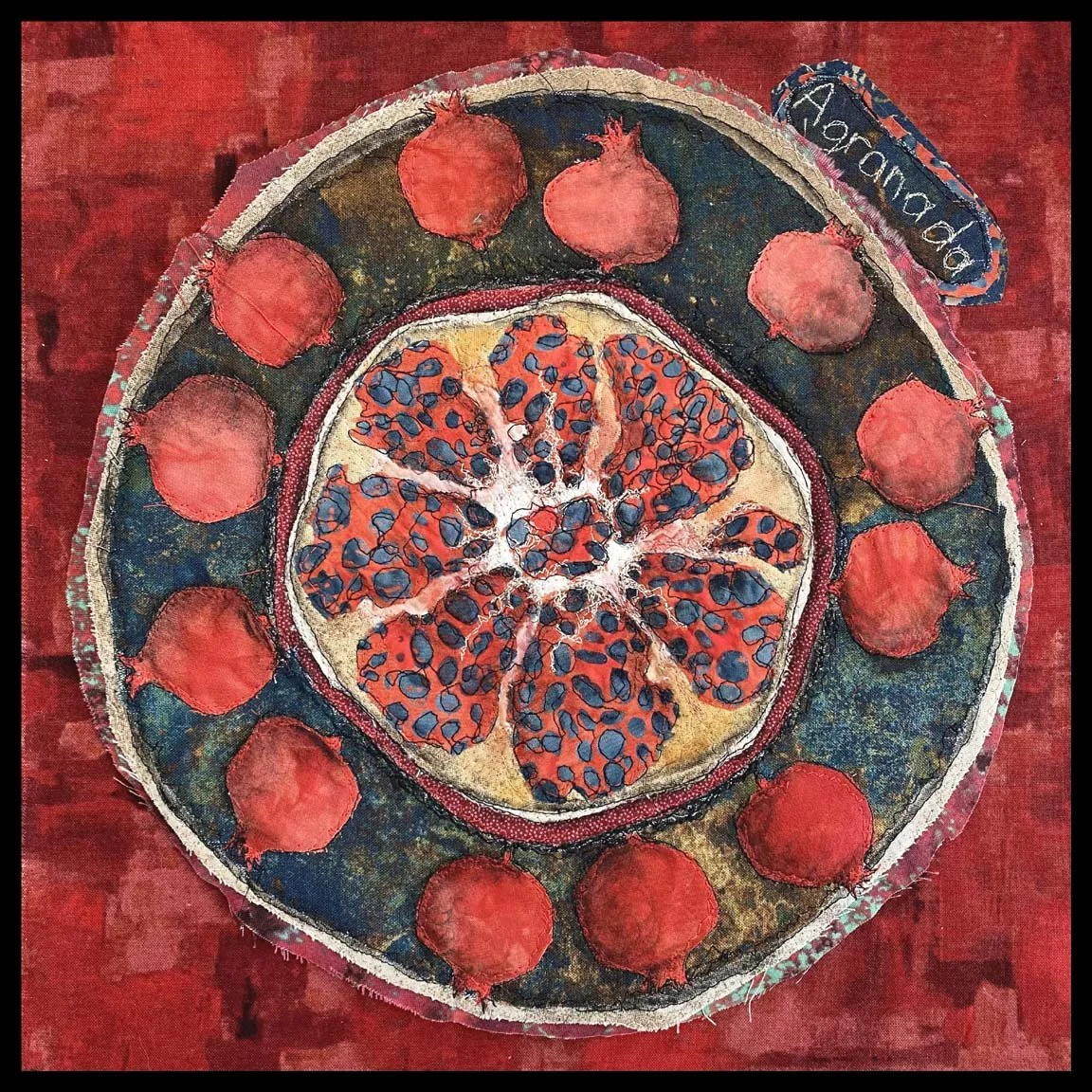
Agranada: Pomegranate
Language: Ladino (Judeo-Spanish)
Region: Sephardic Jews of the Mediterranean
From a Turkish Sephardic idiom: "Avrirse komo la mangrana" means to open oneself like a pomegranate, and thus to provide many opportunities (of) health, wealth and beauty…. Those who speak Ladino in Turkey today are based mainly in Istanbul and Izmir, and are over sixty years old. Over Rosh Hashanah they teach that pomegranates can be regarded as metaphors for the need of unity of compassionate humans and prosperity among Turkish Sephardim.
In this piece, I focused on the generative power of the pomegranate, showing a cross section of the fruit, and that each seed is the beginning of a new cycle of life.
For the full description, along with pronunciation, map and video, click HERE.

13X13" shadow box
Aibidil: Alphabet
Language: Gaelic
Region: Western Scotland
Aibidil is the Scottish Gaelic word for ‘Alphabet’. The Gaelic Aibidil has 18 letters and each letter is represented by a tree. The oldest living thing in Western Europe is a 2,000 years old Scottish Yew tree in Fortingall.
Gaelic is one of the oldest languages spoken in Europe today. It is more than a thousand years older than English and still spoken in Scotland and Ireland.
This ancient affinity between the Gaelic word and the tree embeds a deep association between language and landscape in the original roots of Gaelic. It gives an ecological substance to the alphabet – the foundation of all literacy – a language we can learn by looking at the landscape.
With this piece, I chose to portray a grove of trees rooted deep into the layers of earth, drawing up into their canopy the rich expressions of the Scottish Gaelic tongue. The layers can also be read as tree rings.
For the full description, along with pronunciation, map and short video, click HERE.

13X13" shadow box
Chalay: The practice of barter and exchange
Language: Quechua
Region: Peruvian Andes
The practice of chalay (or chhalay) embodies the Andean concept and value of reciprocity. It represents an ancestral alternative economic system which values, people, land and the sacred nature of food. Reciprocity is found at the heart of all relations, such that there are exchanges between people and mother earth, the apus (sacred mountains), plants and animals.
Historically in the Andes, non-monetary exchange has been linked to the ideals of economic and ecological complementarity, and contributed to self-sufficiency, not to economic gain. Although Andean farmers are now integrated into modern monetary economic relations, chalay continues to provide access to important goods and services without money. The farmers who practice chalay exchange foods, calculating the value of the products. In this case, value is not equivalent to the monetary value; rather it considers the time and effort for production, transportation, and takes into account the social relations between those doing the bartering, and the needs of the participants. The exchanges strengthen the relationships between family members and friends from different agricultural zones.
In this piece, we see corn and potatoes making up a large portion of the exchanges. They come in a riot of colours and shapes, each with their own particular use in cooking or animal husbandry.
For the full description, along with pronunciation, map and short video, click HERE.

13X13" shadow box with glass
Coble: A traditional open wooden fishing boat built without a keel
Language: Northumbrian Coastal Speech
Region: Northumbrian Coast, UK
The word ‘coble’ refers to the wooden boat traditionally used for inshore fishing on the NE English coast between Berwick-upon-Tweed in Northumberland and the Humber in Yorkshire. A coble is more than just a boat. Built by the eye, without a plan, its lines evolved over centuries for sail, to respond economically to the wind and local sea conditions. Its characteristic shape, deep ‘forefoot’ and flat bottom aft, developed in response to the need to launch from beaches.
As the focus of a family-based economy, a coble embodied the traditions, beliefs and values of concentric human circles: its crew of three men, their families, the village, and the culture of the entire coast. It required many skills – boat-builder, joiner, blacksmith, sail-maker or engineer – and supported local businesses selling paint, linseed oil, paraffin and ‘perrins’ of thread. In short, a coble represented a whole community.
For this piece I chose as model a traditional blue and white coble with its distinctive red sail. Alongside it run the salmon, one of the many species of fish and shellfish captured through the seasons.
For the full description, along with pronunciation, map and short video, click HERE.

13×13" shadow box
Danbwa: in the woods; wild overgrowth; wilderness
Language: Kreol Morisien
Region: Mauritius
Danbwa is a word that is literally translated into ‘in (dan) wood (bwa)’ and would be a synonym for ‘bwa’ (wood). Subtle variations of the word bring nuanced meanings, such as, separating it into two ‘dan bwa’ to describe ‘in the woods’ or the motion of going into the woods.
Danbwa is a word used to represent the woods or wilderness. For some it brings to mind the forest and trees. For others, the latter could also mean the wild nature or the notion of savagery – as applied to humans too. ‘Danbwa’ can also mean ‘unexploited’ and ‘undeveloped’ land, where the forest and natural ecosystems are perceived as ‘empty land’ which is meant for human intervention, construction, and exploitation.
I was drawn to this word because it's so obviously rooted in French, my first language. I tried to put myself in the crazy, wild woods one might find on a tropical island upon discovery.
For the full description, along with pronunciation, more images, a map and video, click HERE.
13×13" shadow box with gallery glass
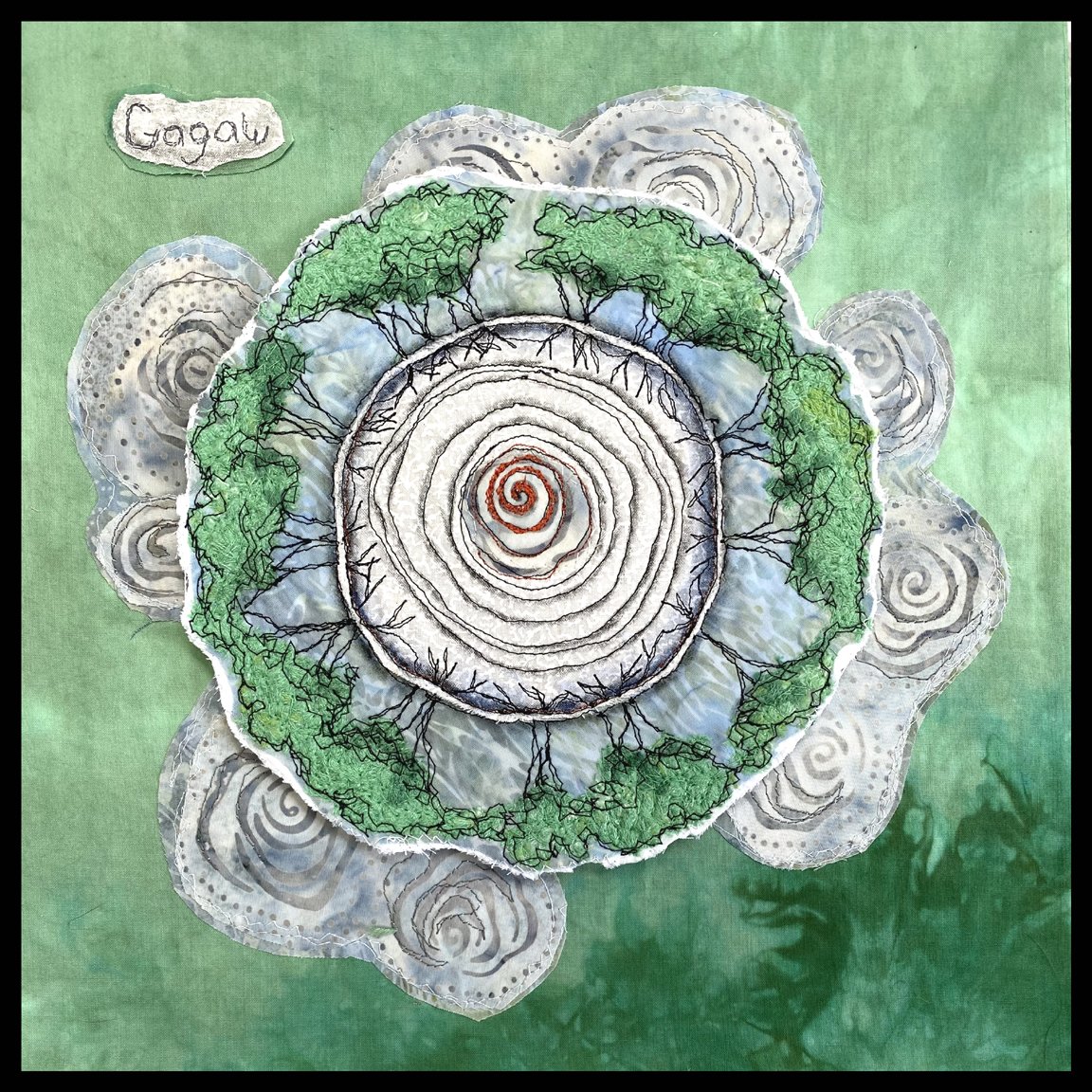
Gagaw: love; the universal principle
Language: Higaonon
Region: Northern Mindanao, Philippines
"The word gagaw means love. It is the love of the Creator – the one who made all peoples. It is the universal principle of how the tribes work, and it is how the wisdom of the ancestors moves to the current generation. We believe that the past is the foundation of tomorrow; the ancient cultures are our guidance.
Through gagaw we are connected to all ancestral spirits and to the rainforest. Gagaw is the language of the rainforest, of the running water, of the air and of the clouds. Every morning, new life comes through gagaw. When that wisdom is lost, how can we communicate with Mother Earth? We have to show gagaw to nature."
This piece shows the cross section of a tree and its rings, which hold the wisdom of the past. Its centre is circled with red for its hearbeat. Around the circle is the forest which represents new life, drawing water into its roots. And the air and clouds hover over the trees, all connected to the whole.
For the full description, along with pronunciation, map and short video, click HERE.

13×13" shadow box with gallery glass
Hyká - name; stone; speech
Language: Mysk Kubun
Region: Central Colombia
"The stones are the word, and the latent memory of our territory and of our ancestors. They are proof that they walked through these mountains. They are grandmothers who know a word, ancient, deep and complex; words of advice that can only be heard through patience, deep silence, and the other senses."
In this piece the grandmothers' voices drift upward through the stone, to be heard by those in this world who are listening.
For the full description, along with pronunciation, map and short video, click HERE.

13×13" shadow box with gallery glass
Ïe cho: Good path
Language: Muysk kubun
Region: Central Colombia
We say:
"Our ‘living well’ is Ïe cho (good path); it is being aware that we are all part of Mother Earth.
It is devoting our life as human beings to uniting with the territory we inhabit and in which we’ve been sown.
Ïe cho is taking care of the territory.
It is taking care of our relationship with birds, the wind, the earth, water, fire, trees, plants, stones, our ancestors and all the spirits that walk with us.
It is taking care of our family, our traditions, our memory. It is forgiving the past and making peace with it.
Walking Ïe cho is understanding that when we become earth again, our body returns to our mother."
In this piece the path begins at the top with birth, and meanders with the kindred spirits of the forest. At the end of the path, we return to the earth.
For the full description, along with pronunciation, map and short video, click HERE.
13×13" shadow box with gallery glass
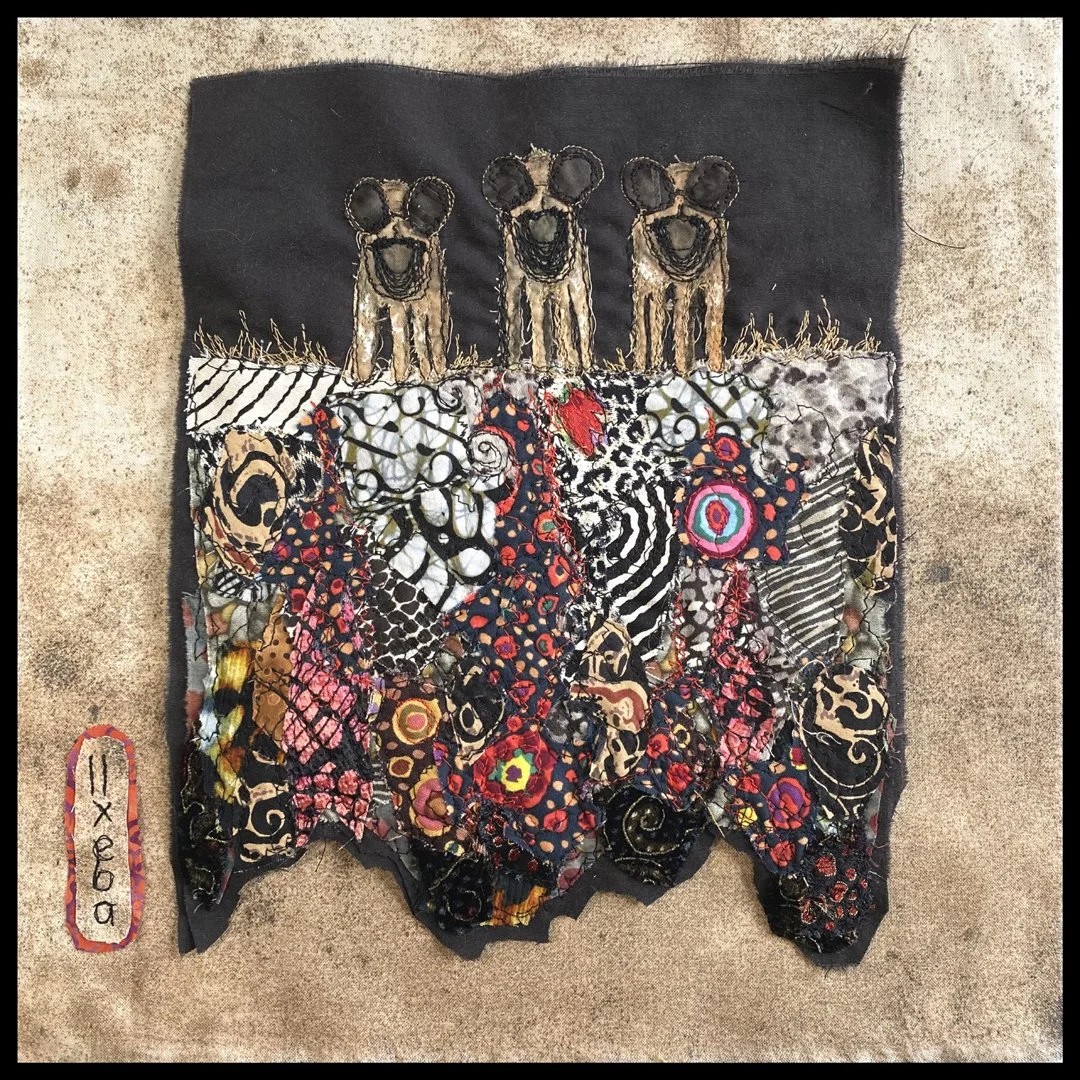
IIXéba: African Wild Dog
Language: Khwedam
Region: Northeastern Namibia
The Khwe, like other hunter-gatherers of Southern Africa, have a special relationship to the African Wild Dogs. The Khwedam name for them is ||Xéba but they are also referred to as Khyanici Tooapa, the sacred dogs of the female God. The Namibian Khwe community respect and fear these predators, and assign them special powers.
When cattle people arrived in Southern Africa some 2000 years ago, they started killing the African Wild Dogs as the dogs went after their cattle.
The three dogs in this piece were inspired from a photograph by Dale R Morris. Here they stand, perhaps defiant, perhaps curious, while their beautiful, complex world burns beneath them.
For the full description, along with pronunciation, map and short video, click HERE.

13×13" shadow box with gallery glass
Itrofillmongen: Set of tangible and intangible elements central to Mapuche life, including spiritual energies or newen and the che or human person as indissoluble parts of the diversity of life that makes up each space or Lof that we inhabit.
Language: Mapudungun
Region: Lake Budi, Mapuche Territory, Chile
For the Mapuche, all the elements of nature are vital. In their worldview, everything is alive: soils, lakes, oceans, rivers, water springs, forests, wetlands, flora, and fauna, and together they allow them to live in balance and fullness. The balance of each of these elements on earth is intrinsically linked to the health and integral development of the Mapuche in the earthly and spiritual aspects.
I wanted to portray balance and what better way than the yin-yang design. Dark and light, earth and sky, water, plants, other beings... in constant flow and states of life, all essential to the fullness of life.
For the full description, along with pronunciation and a video and map, click HERE.

13×13" shadow box with gallery glass
Ixau: to shoot with a magical arrow or go on a magical expedition
Language: ǀXam
Region: Southern Africa
Says Sylvia Vollenhoven, indigenous South African author, playwright and filmmaker: "The word concept |Xau, unearthed in an ancient dictionary, is a powerful example of what we have lost. The newer languages, inept by comparison, that have come to replace the rich indigenous lexicons do not have a word that comes close in meaning to “shoot with a magical arrow”.
Tumbling around in the maelstrom of the modern world, in search of what we have lost, we need to find those magical arrows. We need to find the |Xau of now to restore our relationship with the land and the divine within. Only then can we return to valuing the earth once more. Only then will we begin to heal what has been destroyed without and within."
In this piece is the bow, about to release an arrow that may lead to any of a number of magical possibilities.
For the full description, along with pronunciation, map and short video, click HERE.

13×13" shadow box with gallery glass
Kallpa Warmi: women's strength
Language: Quechua
Region: Ayacucho, Peruvian Andes
In the video that accompanies this word, Violeta Quispe and her mother talk about the significance of ‘Kallpa warmi’, or women's strength, in the transmission of their traditional Andean legacy. Together they are preserving elements of their Quechua culture in the face of discrimination and oppression. The Pelican feather portrayed here is a traditional art tool for creating coloured panels that tell stories both ancestral and current. They are also reviving the arts of embroidery, sewing, weaving and songs.
For the full description, along with pronunciation, map and video, click HERE.

13×13" shadow box with gallery glass
Kyká: world; town; story; region
Language: Muysk kubun
Region: Central Colombia
"The myth is recreated in the everyday, in the day to day, giving meaning to existence while walking.
Our people once again raise their houses, raise their spirits, their voices. In the infinite gaze that meets the glow of the sky at dusk and becomes breath the next morning. When the sun struggles to penetrate the multiform droplets of fog and smoke crawling through the straw of our ceremonial houses.
To be the hope of a people that walks the roads in daily activity, surprise filling every step in the amazement of another life that crosses the road, showing its colours of flight."
Here is the ceremonial house, warmed by the fire's spirit that reaches toward the morning sun. The forests protect the people, and the fields help nourish them.
For the full description, along with pronunciation, map and short video, click HERE.

13×13" shadow box with gallery glass
Maloka: Ancestral longhouse
Language: Murui (Uitoto)
Region: Amazon region, Colombia
The ancestral and spiritual longhouse of the Murui-Muina, the Maloka, houses multiple families who cook and hang their hammocks in separate spaces. It is where the men chew coca and tobacco and where the women prepare sweet yuca, and where the elders gather to discuss and manage the affairs of the community. It is also where the dance of the Yadico (the Dance of Unity) takes place. In this process, which takes 15 days to prepare and lasts through the night, the Murui endeavour to heal the tensions and disagreements that arise within and between their communities. Resentment and discord are dissipated and the community re-weaves its harmony.
At the same time, the whole community gathers to strengthen and heal its intimate relationship with the natural world, and transmits the ancient wisdom and practices to their children and young people.
I have placed the Maloka at the top of a woven cloth interspersed with green forest leaves, to show that the forest is an intimate part of the life of the Murui. A harmonious connection with nature is as important as closeness within the community, and the Maloka is the centre of this connection.
For the full description, along with pronunciation, map and short video, click HERE.

13×13" shadow box with gallery glass
Morfa: a place of, near or shaped by the sea
Language: Welsh
Region: Wales, UK
In the standard historical Welsh Dictionary the word ‘morfa’ is defined as a low lying wetland (usually by the sea) that is periodically inundated by water. A ‘[sea] marsh, salt marsh, fen, moor’. The dictionary notes that the word ‘morfa’ has also been used in the past for land that can become flooded along inland rivers – but only in one part of south Wales. The word ‘morfa’ literally means ‘a place of, near or shaped by the sea’.
A high-water fringe of tangled seaweed, crab carapaces, soggy seed heads and wispy plant stems, fishing nets, sea-chewed rubber balls, plastic shards and lost shoes. And the birds: always watching, waiting and following the tide as it silently fills and then empties the marshland – until the creeks become mud-reeking bobsleigh runs. Slick and treacherous. In-between places. Fickle and fascinating. So still, somehow – yet forever on the move.
For this image I chose an imaginary interpretation of an aerial view of such a place, where the tide is washing back, leaving a labyrinth of pools and rivulets. The white dots represent sea birds, like the endangered Lapwing so well loved for its distinct cry.
For the full description, along with pronunciation, map and video, click HERE.

13×13" shadow box with gallery glass
Napuro: a forest that looks like ‘an island within an island’
Language: Cuyonon
Region: Cuyo Islands, Philippines
"In Cuyonon, we have a forest ecosystem called napuro. Literally, napuro means ‘became an island’ and is characterised by big old trees in the middle area, outlined with huge rocks, creating a territory of its own – an island within an island. Fruit-bearing trees thrive inside it, including kasoy ’cashew’, lumboy ‘Java plum’, and even santol ‘cotton fruit’. We also rely upon napuro for a specific type of bamboo that we use for furniture, and even for inyam ‘Queensland cherry’ – a kind of wild cherry whose leaves are both cows’ and goats’ favorite.
Napuro is approached with care. First, inside napuro resides a ‘lure of the unknown’ that can mimic one’s voice from any direction. It can also mimic a companion’s voice, tempting one to follow it and eventually lose one’s way home."
I used an aerial view of Napuro to show the rocks surrounding the 'island within an island". The entrance to the Napuro is important... one must know where and how to approach and return from this mysterious and bountiful space.
For the full description, along with pronunciation, map and short video, click HERE.

13×13" shadow box with gallery glass
śaff: track; print; unexpectedly, it turns out to be
Language: Mehri
Region: Southern Oman
Tracks, like fingerprints, reveal an indisputable identity that may otherwise not be recognised. My fingerprint is unique to me, and my footprint is likewise unique. In the desert from afar you may believe you are following a camel from one herd, but on close examination of the tracks of that animal discover you are tracking a camel from a different herd. The track, therefore, reveals the unique identity of an animal or a person, and by extension śaf has come to be used where an action, object or event that was originally thought to be one thing unexpectedly turns out to be something else.
Younger speakers in Southern Oman might use śaf in sentences such as: śīnək ḥaybīt əkabs ḥaybayti śafs ḥaybitk ‘I saw a camel I thought was my camel, but it turned out to be your camel’. But they might not appreciate the link between this turn of phrase and the vital social importance of tracking for Mehri and Shehret livestock herders in the past. The track reveals identity without ambiguity, and skilled tracking can be a question of life or death.
The progressive paving of the environment, as social, economic and environmental forces shape Mehri and Shehret society, mean that the activity and terminology of tracking is being lost.
In this piece we can clearly see camel tracks on the desert sand, disappearing on the ashphalt. The desert burns away below, as human encroachment defeats the natural landscape.
For the full description, along with pronunciation, map and short video, click HERE.
13×13" shadow box with gallery glass
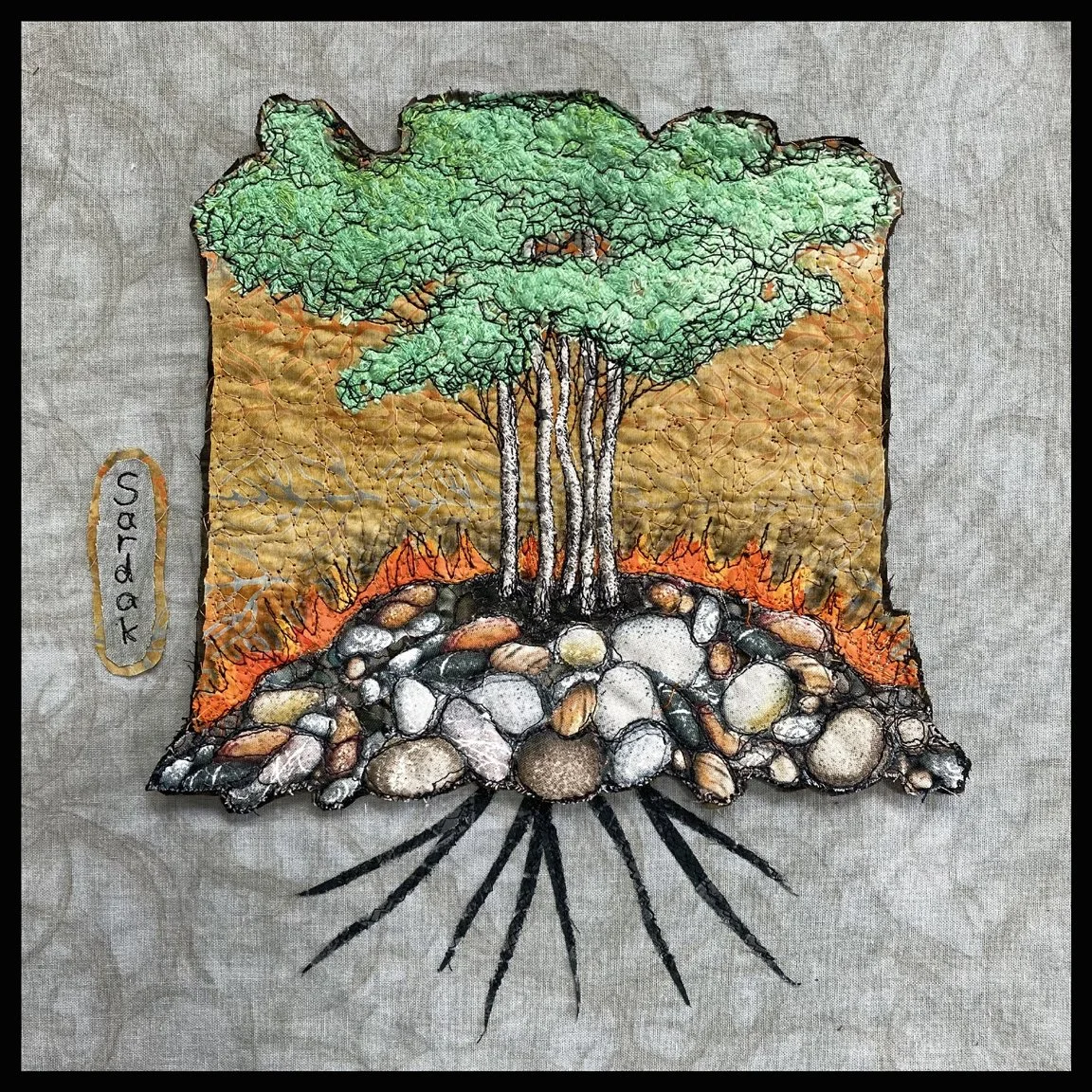
Sardak: the ancestors and owners of the land
Language: Ladakhi
Region: Ladakh, India
The word sardak means much more than ‘owner of the land’’. The roots of the word, with their tentacles, meander and take us to the first person (the original sardak of a household) who established the first farm, which gave him/her the food, leading to the formation of his/her household. The household members created the first romkhang: the place where the dead person’s body was burnt to convert it back to soil and rocks. The following generations were also converted to dust in the same romkhang. Siblings parted ways and the number of households grew: new romkhangs were made. The new, however, must have a handful of the soil of the original romkhang. So all the people who found a place in the romkhang are dakpos; owners of the land (sardak).
Romkhang, is an odd word. It means the house (khang) of the dead body (ro). But the body is not just a body; it also is soil/land. Dust in any romkhang is a mixture of the bodies of the ancestors. The grove of trees, a feature of the village landscape, owes its existence to them.
In my interpretation, the dust of the sardak, rooted deeply in the land, nourishes a grove of birch.
For the full description, along with pronunciation, map and short video, click HERE.

13×13” shadow box with gallery glass
Scrogs: brushwood or undergrowth; stunted or crooked bush or tree
Language: The Doric
Region: Northeast Scotland
‘Scrogs’ is a thicket – not the extensive cover of improved woodland, but more open landscape with intermittent trees and bushes. The word ‘forest’ is still used to describe the treeless Scottish uplands where deer are still stalked. ‘Scrogs’ harks back to a time before land enclosure, and looks forward to today’s industrialised forestry where trees are seen as just one more cash crop. Single species planted and harvested – the antithesis of biodiversity.
I learned that one of the many species inhabiting Scrogs land is the Hawthorn shrub, Crataegus laevis. This plant is familiar to me because it was introduced along with many others and freely crossed with our own native species here. Hawthorns are beautiful small trees that bear delicious red fruit, a delight for humans and wildlife alike. However their long sharp thorns are a deterrent in brushy areas, making them a good refuge for escape! Here the shrub is portrayed above its many layers of natural history protected and hidden by the soil.
For the full description, along with pronunciation, map and short video, click HERE.

13×13" shadow box with gallery glass
Siwa: pond; lake; vagina
Language: Muysk Kubun
Region: Central Colombia
The lake is that portal from which possible worlds are born and where the spirit of struggle and natural order is strengthened. Our waters are creative centers, navels and connection paths that allow us to dialogue with other ways of thought.
Its waters sing stories, siwa speaks to us and reminds us of the womb, of the humidity of our first ‘mochila’ (cotton shoulder bag), our mother’s womb.
Returning to the lake is to reimagine ourselves, to look at ourselves in the mirror of its waters and recognize ourselves to organise our thoughts and spirit.
For this image I chose the cross section of a lake, from which arises all creative energy, to be released through our own human spirit.
For the full description, along with pronunciation, map and video, click HERE.
13×13" shadow box with gallery glass
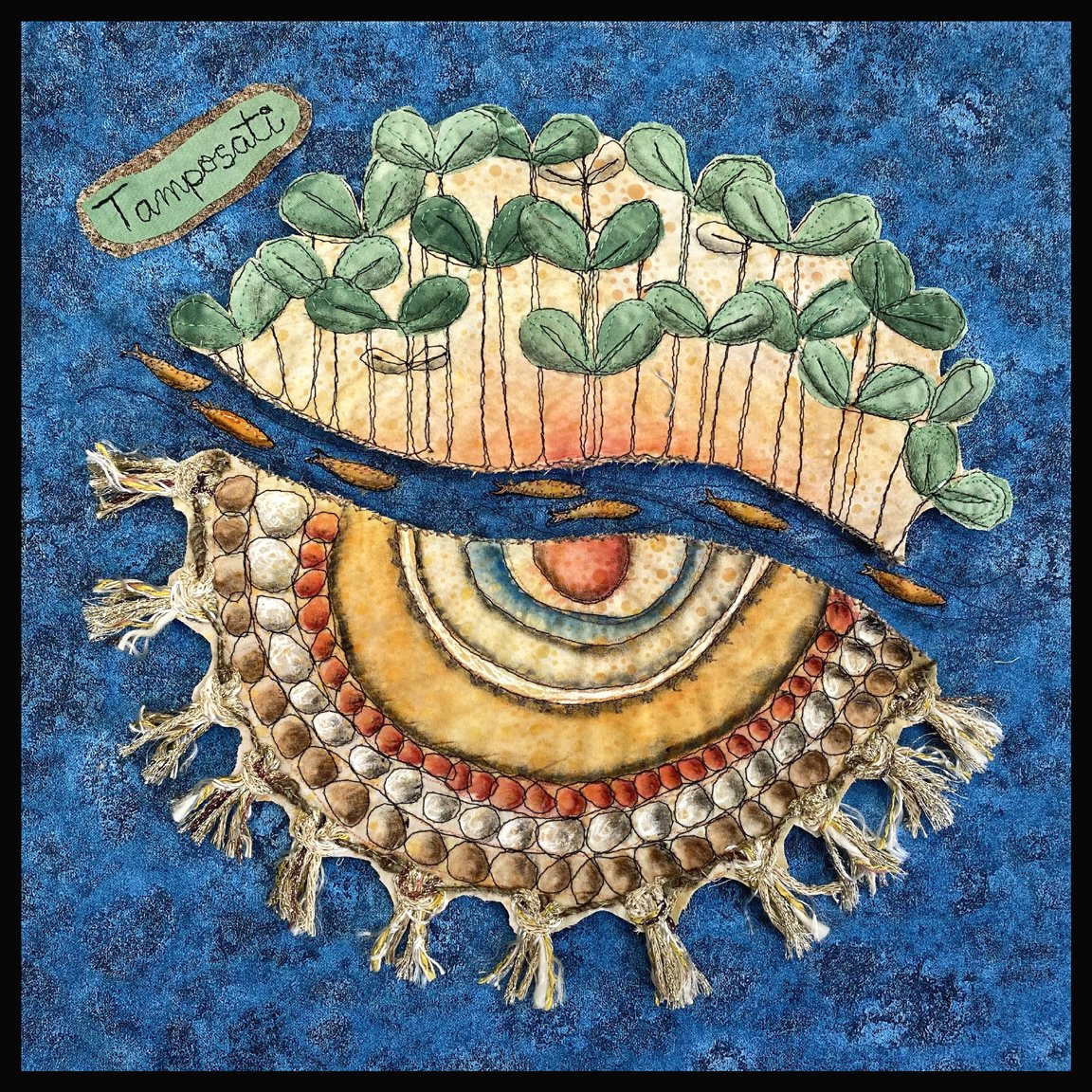
Tamposati: Those born in the Rio Tambo
Language: Asháninka
Region: Junín Region, Peruvian Amazon
In the words of Yessica Sánchez:
"My father says that Tamposati means that we are those born in the Tambo River, guardians and caretakers of our nature. For me, Tamposati is my home, I lived my childhood there, I had the joy of enjoying everything that nature provides.
Since I was a child, my parents taught me to sing. Today I reaffirm my cultural identity as an Asháninka woman singer and I make myself visible through my cultural expressions such as my clothing, my customs and my language, raising up our culture.
Our culture is alive and so is our technique. I am proud to carry this legacy with me and to be able to share the beauty of our culture with the world. Preserving our language is important for future generations to enjoy our cultural richness."
This piece features an interpretation of a necklace worn by Yessica, along with the colour of her woven tunic. The river flows between her ancient culture and the seeds of renewal that she plants in her present life.
For the full description, along with pronunciation, map and short video, click HERE.

13×13" shadow box with gallery glass
Tshinanu: The inclusive ‘we’ - all as equals
Language: Nehluen, Innu language
Region: Nitassinan - a territory that spreads from the south-west of Quebec, to the north-eastern coast of Labrador, Canada
To better understand the base of the Innu language, we have to position ourselves in the context of circular thought. A human being and his environment are indissociable in this kind of thought. The pronoun ‘we’ will serve as an example to better understand the possible shades. If I wanted to speak of ‘we’ which includes me and you (singular or plural), then I would use ‘TSHINANU’. The prefix ‘TSHI-‘ corresponds to you in all its forms. If I wanted to speak about ‘we’ but in a way which is excluding you, whether singular or plural, I would say ‘NINAN’ (with the accent on the second N). Tshinanu – the inclusive form of we – invites sharing, community life, as there are no fences in the word tshinanu. It is a collective ‘we’, an open hand extended to others, inviting them to be a part of the circle. It also correspondingly tells a story, the story of the community of life of the person who speaks or writes.
This word brings into relation the land, the animals, the plants and the peoples in the same pronoun.
With this piece I am showing that every colour, every shape, carries equal importance and contributes to the whole. The dandelion head design, with each seed head ready to send its progeny into the future, also points to openness and generative power of this world view.
For the full description, along with pronunciation, map and short video, click HERE.

13×13" shadow box with gallery glass
Tuuca Orodji: Rainwater pan
Language: Khwedam
Region: Northeastern Namibia
The few thousand Khwe are one of the hunter-gatherer communities who until very recently lived by foraging in their ancestral hunting grounds in the north-eastern part of present-day Namibia. Some decades ago, these areas were declared a game reserve and since then the Khwe are no longer allowed to hunt; even the traditional gathering of bush food has been severely restricted. At the same time, farmers enter the former hunting-grounds of the Khwe with their cattle and destroy the natural resources – the water pans and the trees – both key to the livelihood of the Khwe community and the wild animals.
In the semi-arid land of the Khwe, tuuca orodji ‘rainwater pans’ are the most important water resources in the bush.
For this piece I used as model the areal view of one such rainwater pan, which shows in its rings its ever decreasing volume as the dry season progresses, as well as the living plants it sustains along the way. I added animal/human tracks radiating to and from. This type of motif reminded me very much of tree rings!
For the full description, along with pronunciation, video and map, click HERE.
13×13" shadow box with gallery glass
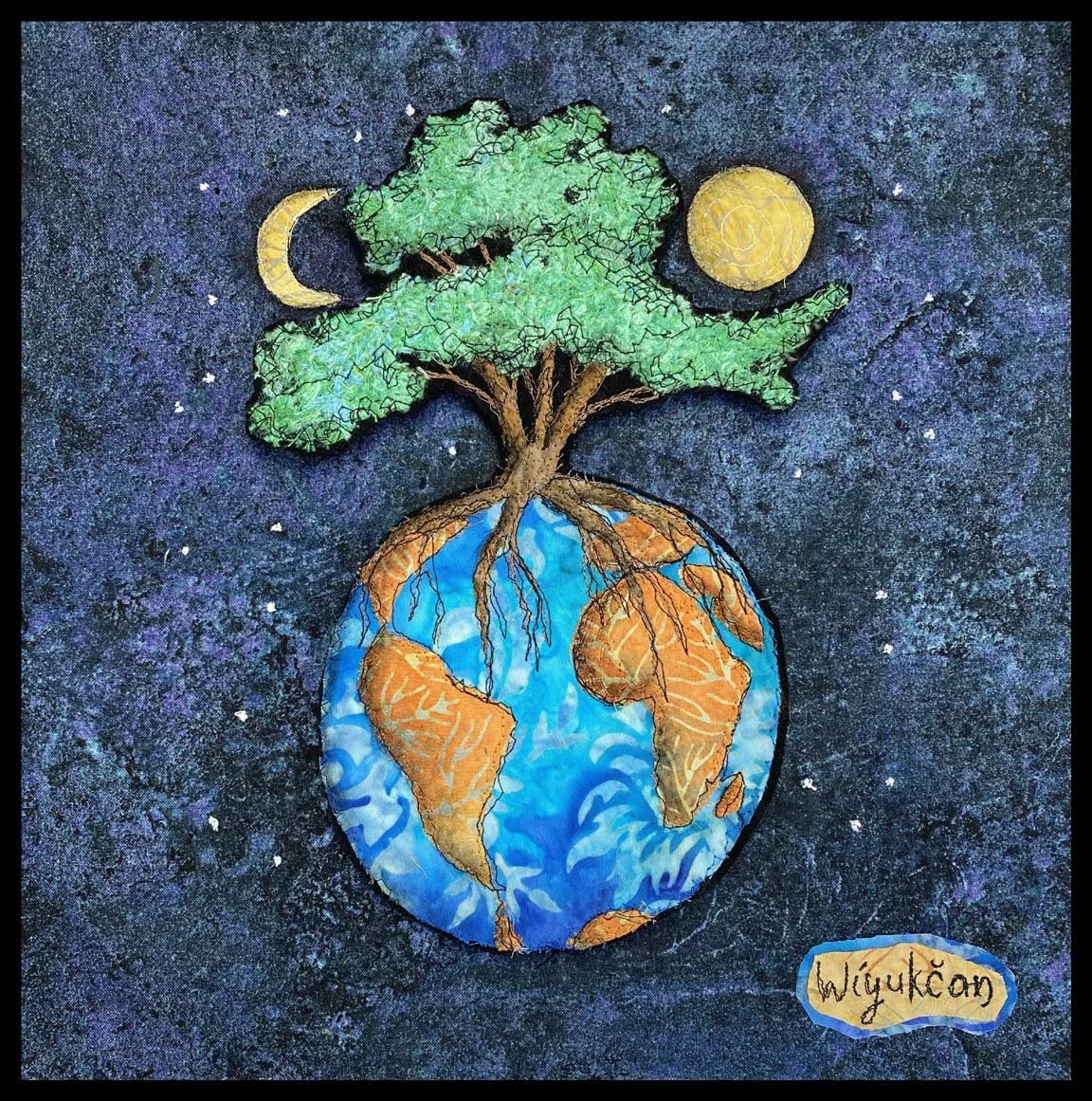
Wíyukčaŋ: Consciousness; knowing
Language: Lakota
Region: Great Plains, Central United States
Tiokasin: čaŋ is a tree – so we are talking about a torso, we are talking about the finger, the arm, and our hair is the leaves, you can go on, and our toes are the roots. It’s not just that your body is a tree – it’s the wíyukčaŋ – knowing, consciousness. You hear the čaŋ in it? So, in Lakota thinking, when you fragment the word: wí-yu-kčaŋ… Wí is the sun and to us, sun is a verb – it is being and it is always alive. And the yu is like the consciousness that is given to the tree and the tree is acknowledging the sun. This is not just us as the body of the tree, but this is the tree of who we are. We can spiral out into a bigger thought: Wow, the consciousness of the sun is the consciousness of the tree and vice versa. And we are the acknowledgement of it because look how we are made. We don’t have the language for that in English. I am speaking so many English words to describe one little thing!
Wíyukčaŋ – that’s knowing, consciousness – the wíyukčaŋ is also involving the moon and the stars and the trees of the earth and how they communicate, and we are in that as humans.
For this piece I chose the tree, with roots embracing our planet, and included the moon, the sun, and the stars to show that all is connected.
For the full description, along with pronunciation, map and short video, click HERE.

13×13" shadow box with gallery glass
SOLD
Yii: Tree, wood, medicinal plant
Language: Khwedam
Region: Northeastern Namibia
We say:
"Yii means trees, wood and medicinal plants. Yii as trees are crucial for finding the way in the bush and are our main food sources, yii as wood is essential for making most of our tools and instruments, and yii is also the name of our medicinal plants.
Until recently, children from an early age accompanied their parents on hunting and collecting parties in the bush. During these trips, they were taught to observe and remember the trees in order to be able to find their way back home.
Yii is also the wood from which we make our tools, such as the handle of the axes and hoes, the clapping wood instruments, the mortars and pestles; we also build our houses with yii.
Medicinal plants are also yii and because of that we call our healers yii khoe ‘yii people’ or yii kx’ao ‘powerful yii people’."
With this design I placed Yii, the Tree, front and centre. She brings nourishment up from the soil. She is the compass. She provides shelter with her shade and her wood. She offers medicine. Yii is the Tree of Life for her people.
For the full description, along with pronunciation, map and short video, click HERE.
40" fabric wall hanging
Available from my studio. Contact me with your inquiry. Free shipping across Canada, at cost internationally.
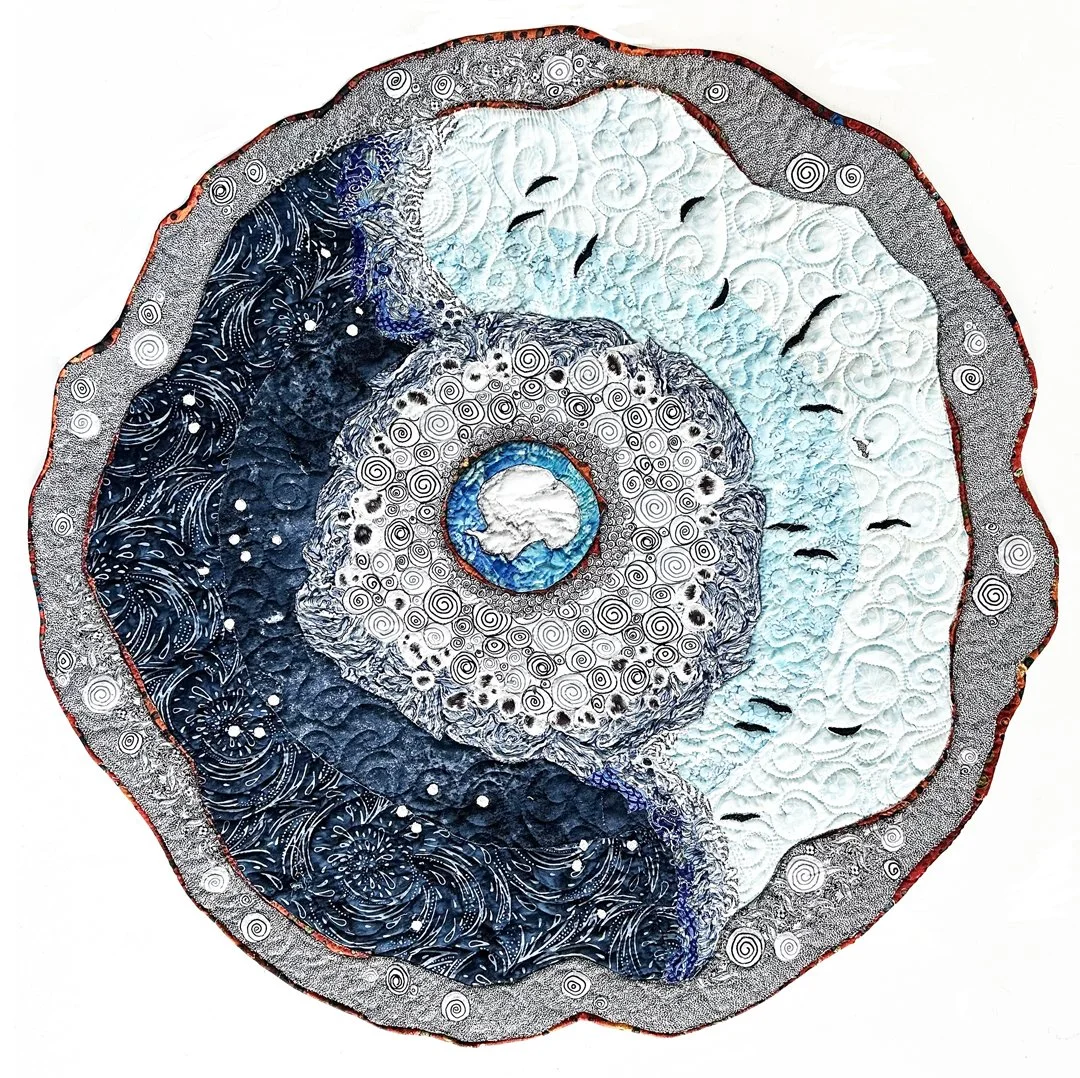
No Word: a continent without words
Language: No indigenous language
Region: Brunt Ice Shelf, Antarctica
‘There are no voices from this frozen continent. There are no people to speak for here, to break the silence. But the stillness above does not tell of the turmoil below. Who speaks for this place? Who will hear, who will listen, as ice tears itself apart?’
"No Word" speaks for a land that never hosted an indigenous human population. However this continent is not without sound... the heaving ice, the wind, the many species of birds, and a few hardy mammals add their voices. The centre of this piece features the continent, nested in water. Water molecules are packed evenly around it in the form of ice, but are slowly released as water, then into the air. There are only two seasons in the Antarctic: Winter and Summer.
For the full description, along with pronunciation, map and video, click HERE.
40" fabric wall hanging
SOLD
This wall piece pulls together all the ideas behind this project. All the words, growing from the earth, drawn up by trees and nature, and released through our communications and relationships. Here are all the colours, all the words, all the world.